
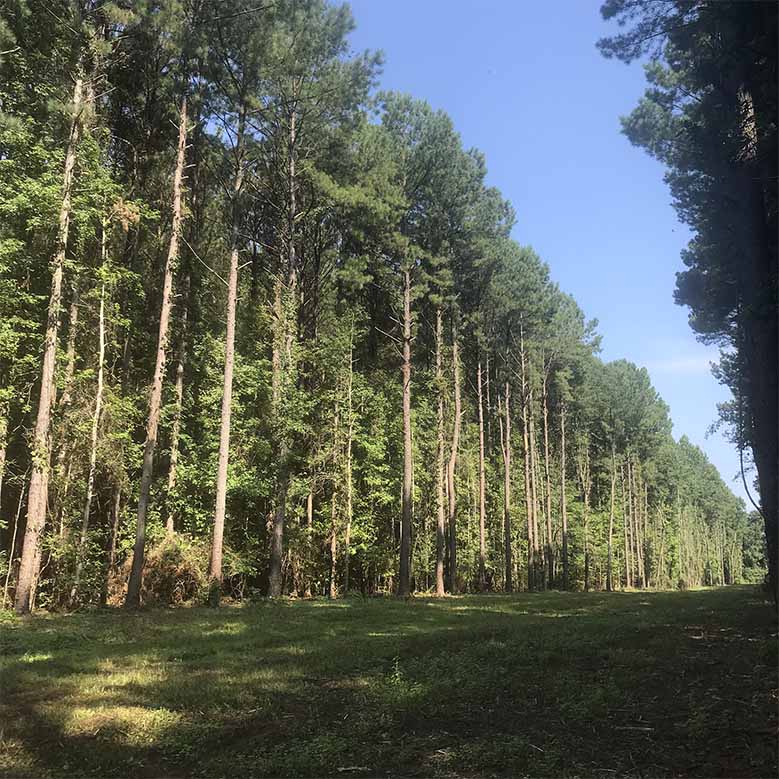
Short answer: there is no single current timber price per acre in Mississippi or Alabama. What standing timber is worth on a given tract depends on species, product class, merchantable volume per acre, stand and tract conditions, access, haul distance to a mill that wants that wood, and how many qualified buyers are asked to compete for it.
Southeast Forestlands does not publish real-time stumpage quotes, and no online estimator can price a tract it has never seen. Published statewide and regional reports show market direction. They do not measure your timber.
- Species and product class. Pine pulpwood, chip-n-saw, pine sawtimber, poles, and hardwood grade all price on separate tracks.
- Volume per acre. Tons on the ground — not acres — are what a buyer is actually paying for.
- Tract conditions and access. Ground that holds a loaded truck, usable roads, and a workable set-up reduce a logger’s risk, and that shows up in the bid.
- Haul distance. Every mile between the deck and the mill gate comes out of stumpage.
- Buyer competition. One offer is one buyer’s number on one day. It is not the market.
That is why an independent timber appraisal built on a measured cruise, or a competitive sealed-bid timber sale, is a more reliable answer to “what is my timber worth” than any online price estimate. An appraisal estimates value. Competitive bidding shows what qualified buyers will actually offer. What follows is a plain-language read on the factors behind those numbers, so a landowner can put a buyer’s offer in context before signing anything.
Why Timber Prices Vary Between Tracts
Unlike a bushel of corn or a barrel of oil, timber is not sold on a fixed exchange. Buyers evaluate each tract individually: what products can be produced, how efficiently the timber can be harvested, how far it must be hauled, and how it compares to the other tracts on the market that same week. Two properties with similar-looking timber can produce very different results depending on how they are positioned and brought to market.
The main levers are consistent across the Southeast:
- Species and product mix
- Stand quality, stocking, and merchantable volume
- Tract size and on-the-ground accessibility
- Proximity to active mills and haul distance
- Local buyer competition on the day the sale is offered
Product Class: Pulpwood, Chip-n-Saw, and Sawtimber
Standing timber is broken into product classes by diameter and end use, and each class prices on its own track:
- Pulpwood — the smallest-diameter product, sold to paper, OSB, and chip mills. It carries the lowest per-ton stumpage.
- Chip-n-saw (CNS) — mid-diameter pine cut into smaller-dimension lumber. Prices sit above pulpwood.
- Sawtimber — the largest-diameter class, cut into structural lumber. Typically the highest per-ton stumpage.
- Poles and grade hardwood — separate pricing tracks that only apply when stands qualify on straightness, knot pattern, and stem quality.
The mix of these classes inside a single stand is often what drives total tract value more than the “headline” price for any one class.
Mill Demand and Local Market Reach
A mill only pays for wood it can actually process. When a regional pulp or sawmill runs full quotas, prices in its procurement radius firm up; when a mill slows or curtails, buyers pull back in that same shed. Because Mississippi and Alabama have a dense network of mills of different types, the shed a tract sits inside can matter as much as the timber itself.
Market activity can shift on:
- Mill quotas and inventory positions
- Regional harvesting activity and available supply
- Weather and ground conditions that concentrate logging onto dry tracts
- Trucking and fuel costs
Access, Haul Distance, and Tract Size
Loggers price risk into every bid. A tract with reliable dry-weather access, a road that will hold a loaded truck, and a manageable haul to the mill will draw stronger interest than an otherwise identical stand that requires long skids, creek crossings, or a marginal county road. Tract size matters too — very small stands can struggle to attract full crews, while larger tracts spread mobilization costs across more tons.
Competition Between Buyers
The single most important factor a landowner can influence is competition. One phone call from a buyer reflects one buyer’s number on that day. A properly marketed sealed-bid process exposes the same cruise to a vetted list of qualified buyers on the same day, and the spread between the high bid and the low bid is the answer to whether the market was actually tested. Whether that produces a materially higher final number depends on stand condition, product mix, access, contract terms, buyer list, and current market conditions.
Reading a Timber Price Report Without Misleading Yourself
Mississippi State University Extension and the Alabama Cooperative Extension System both publish quarterly stumpage summaries. They are useful directional reads for market trend — pine sawtimber firming or softening, pulpwood tight or loose in a given region — but they are statewide averages, not tract-level quotes. A 60-acre first thinning on the south Mississippi Pine Belt and a 200-acre mature pine clearcut in the north-central hills do not share a price, even in the same quarter.
Use a published report to understand direction. Use a measured cruise plus a bid process to understand your specific tract.
How to Use Regional Timber-Price Reports
Guidance last reviewed July 24, 2026.
- Regional averages, not property appraisals. Reported prices are averaged across many sales, tract types, and conditions inside a reporting region. They describe the region, not any single tract.
- Wide variation within the same region. Stumpage values can differ substantially between nearby tracts because of product mix, timber quality, volume per acre, access, terrain, tract size, logging conditions, contract terms, and buyer competition.
- A cruise or appraisal may be needed. When a landowner needs a property-specific value conclusion — for a sale decision, estate work, casualty loss, basis, or partition — a timber cruise or written appraisal is the appropriate tool, not a regional average.
- A sealed-bid sale tests the current market for that offering. A properly marketed sealed-bid sale reflects what qualified buyers are willing to pay for the timber and sale terms actually offered, on the day the bids are opened. It is not a general price index.
Public, authoritative sources for regional context:
- Mississippi State University Extension — timber-price reports
- Alabama Cooperative Extension System — forestry
- USDA Forest Service Southern Research Station
- Mississippi Forestry Commission
- Alabama Forestry Commission
Southeast Forestlands does not republish proprietary subscription datasets (such as TimberMart-South tables) on this page. Landowners who want a subscription-grade regional read should consult those services directly.
Reviews: 4.9 on Google · 181 Mississippi & Alabama reviews.
Getting a Price on Your Specific Tract
The reliable path from “what is my timber worth” to a real number is:
- Have a registered forester walk the property and run a measured cruise.
- Break the cruise out by product class so pine, hardwood, sawtimber, chip-n-saw, and pulpwood are priced on their own tracks.
- Take the cruise to the market through a competitive process — usually a sealed bid — with a written contract that protects the landowner during harvest.
Southeast Forestlands works only for the landowner. We do not buy timber, and we do not work for mills or logging contractors. Our role is to measure what is there, put a defensible value on it, and — when a sale is the right decision — make the market compete for it.
Where to go next: timber appraisals for a written, tract-specific value conclusion; Mississippi timber sales or Alabama timber sales for sale representation; how to read a timber price report if you are trying to interpret published numbers on your own; or contact us to request a tract inspection. The first conversation is free.