
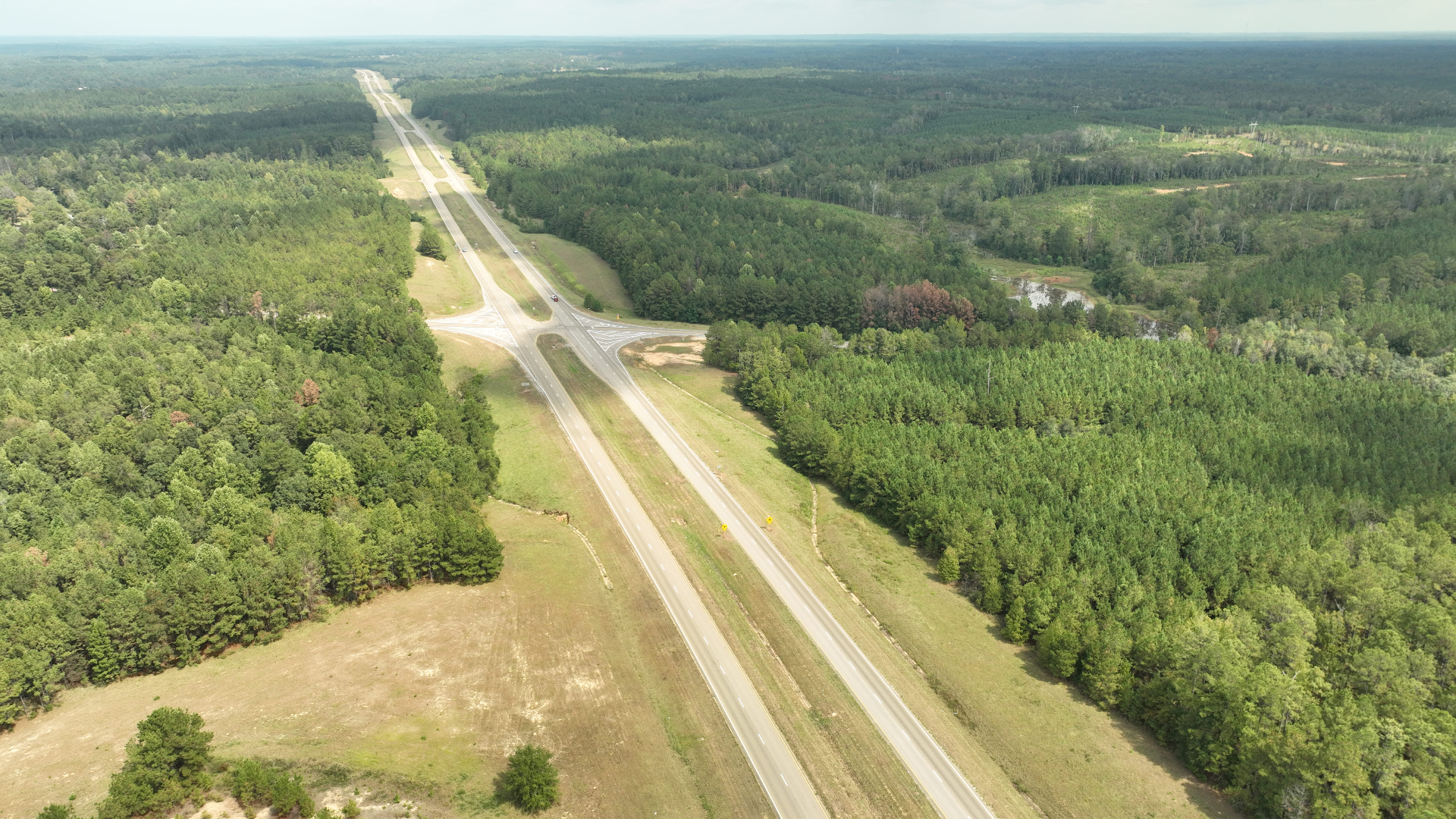
Two timber tracts can look nearly identical and still bring very different prices. One reason is that they may sit in different local timber markets — what foresters and timber buyers often call "mill sheds."
Two identical-looking tracts 80 miles apart can bring materially different stumpage prices for one reason: they sit in different mill sheds. Mill sheds are the invisible market geography of Southern forestry, and understanding them is what separates a realistic sale expectation from a frustrated one.
What a mill shed is
A mill shed is the practical wood-procurement area around a mill — the geographic radius from which the mill economically draws raw material. The boundary isn't a hard line. It's the distance at which the cost of trucking wood to the mill starts to erode the price the mill can pay, until eventually a competing mill closer to the tract pays more.
Different products have different shed sizes. Pulpwood sheds tend to run 50–75 miles because the per-ton value is low and trucking economics dominate quickly. Sawtimber sheds can extend 75–125 miles or more because higher per-ton value supports longer hauls. Poles, with the highest per-ton value, can travel even further.
Why sheds matter so much for stumpage
Stumpage is what the mill can pay minus the cost of logging, trucking, and the buyer's margin. The mill price minus the haul is the ceiling on stumpage. Two tracts 30 miles apart with the same stand and the same volumes can see meaningfully different stumpage if one is in the heart of a dense mill cluster and the other sits on the edge of a thin one.
Real example mechanics, no exact dollars: if a pine sawtimber tract sits 25 miles from three competing mills, a buyer is comfortable bidding aggressively because they can place every load efficiently. If the same tract sat 70 miles from one mill, the buyer would have to discount the bid for haul cost and the loss of competitive pressure between mills.
Mississippi mill sheds — the regional picture
Mississippi has unusually dense mill coverage by Southern standards, which is why the state often shows healthy stumpage prices relative to volumes. Notable concentrations include:
- South Mississippi pine belt — Hattiesburg, Laurel, Wiggins, and Bogalusa (LA) form a dense cluster pulling pulpwood, CNS, sawtimber, and poles from Jones, Forrest, Perry, Marion, Lamar, Stone, and surrounding counties.
- Brookhaven–Monticello corridor — A strong mid-state cluster anchored by mills near Brookhaven and Monticello, serving Lincoln, Lawrence, Pike, Walthall, and the surrounding region.
- North-central Mississippi — Ackerman, West Point, Eupora, and the Starkville area form a mill cluster that keeps north-central counties (Choctaw, Webster, Oktibbeha, Clay, Winston) competitive.
- East-central Mississippi — Meridian and the Newton/Lauderdale corridor anchor the mill mix for Kemper, Neshoba, Newton, Clarke, and Wayne.
- Delta-edge — Grenada and the mills along the Delta edge handle wood from the loess hills and bottomland tracts.
Alabama mill sheds
Alabama's mill geography differs because of terrain and product mix:
- West Alabama Black Belt — Aliceville, Demopolis, and Tuscaloosa anchor a cluster that pulls from Pickens, Greene, Sumter, Hale, Marengo, and into adjacent Mississippi counties.
- Southwest Alabama — The Mobile–Monroe County corridor supports a strong pine market on Baldwin, Mobile, Washington, Clarke, Monroe, and Wilcox tracts.
- West-central Alabama hardwood — Hardwood sawmills in the Tuscaloosa and Bibb area pull quality hardwood from the upper Black Warrior and Cahaba drainages.
What changes the shed
Sheds are not fixed. Mill closures, expansions, conversions, and ownership changes redraw them in real time. A new pellet mill can lift pulpwood prices across a 60-mile radius within weeks of starting up. A sawmill closure can quietly soften sawtimber prices for years across an entire region. The current shed map is part of what a working consulting forester tracks, and it's part of what informs a current timber price update.
How sheds affect contract structure
Tracts in dense sheds tend to support more aggressive lump-sum bidding because buyers have flexibility in where to place loads. Tracts on the edge of thin sheds often perform better as pay-as-cut sales, because buyers won't underwrite the haul risk on a lump-sum basis. Knowing which structure fits your shed is part of the marketing decision, not a guess.
What landowners can do about it
You can't move the mills. You can:
- Time the sale. A new mill or expansion 40 miles away changes your pricing reality — knowing about it in advance lets you sell into the lift, not after it.
- Market competitively. Even in a thin shed, a sealed-bid sale with every legitimate buyer in the radius reaches the highest number the shed will support.
- Improve access. Truck-friendly access — paved approaches, durable decks, all-weather roads — directly lifts what buyers will pay because it lowers their trucking cost per load.
- Manage for shed-relevant products. A stand grown for poles inside a strong pole shed is worth more than the same stand grown for sawtimber inside a weak sawtimber shed.
The takeaway
Mill sheds are the silent market force that explains why timber prices vary so much across what looks like the same region. Knowing which shed your tract sits in — and which mills inside it are actually competing for wood right now — is the difference between marketing your timber to the right buyers and guessing.
If you'd like to understand which mills compete for wood on your specific Mississippi or Alabama tract, talk to a registered forester. The first conversation is free.
Talk to a Registered Forester About Your Timber Sale
If you are weighing a sale on a Mississippi or Alabama tract, start with our Mississippi timber sales service page or contact Eric Entrekin, Registered Forester (MS & AL) for a tract-specific review.