
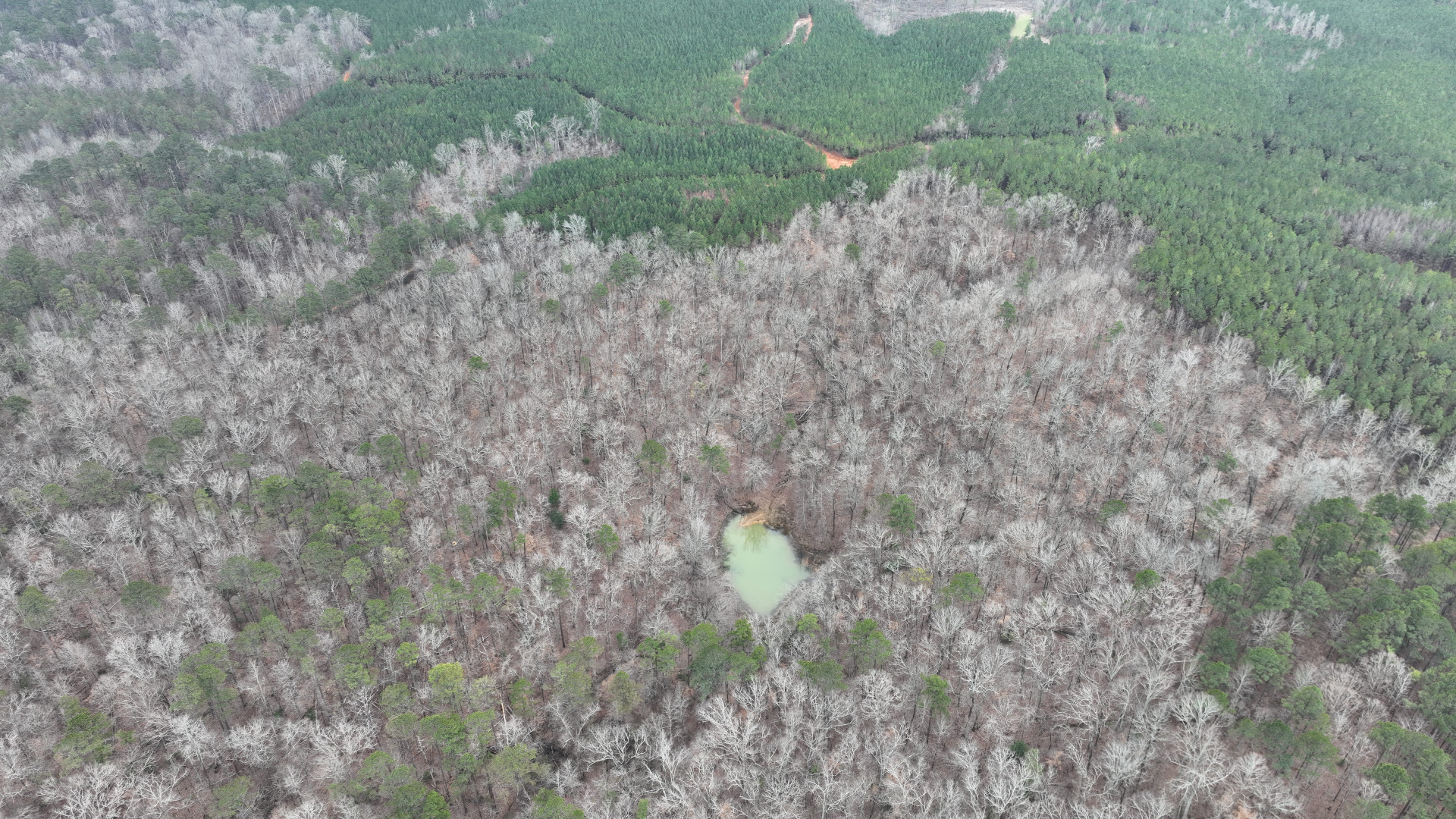
Choctaw County sits in southwest Alabama along the Tombigbee River and the Mississippi line. Geography does much of the work on a sale here: mills at Butler, Pennington, and Demopolis pull one direction, buyers across the river pull another, and the Mississippi-side market adds a third. An unsolicited offer from a single buyer can be compared with cruise data describing the tract’s product classes and access conditions.
Choctaw tracts are commonly worked with a straightforward sequence — an honest cruise, a properly structured sealed-bid offering, and a contract written to protect the residual stand — so the range of qualified bids can settle the value rather than a single conversation.
Terrain, Drainage, and Species in Choctaw County
Choctaw County land is anchored around Butler and shaped by the Tombigbee River and the Bilbo drainage. Typical Choctaw tracts include planted loblolly and longleaf on the uplands, mixed pine-hardwood on the river terraces, and bottomland hardwood along the Tombigbee and Bilbo. The pine/hardwood split within a single ownership can be significant, and the two stand types often carry different products, different buyers, and different operability windows.
Because the drainage pattern threads through much of the county, access on any given tract can change with rainfall. That pattern generally favors planning the sale around a realistic harvest window rather than the calendar quarter.
Separating Products Before the Sale Goes Out
Pine on Choctaw uplands and hardwood in the Tombigbee bottoms can be measured and described as separate product groups. A cruise that separates pulpwood, chip-n-saw, sawlog-grade pine, and bottomland hardwood by product class generally allows each product class to be described and evaluated separately. Separating the measured product groups gives the landowner a clearer basis for comparing an unsolicited offer with other sale options.
On mixed Choctaw stands, that separation may also change contract terms. Bottomland hardwood harvest often calls for tighter language on SMZ buffers, wet-weather stoppages, and skid-trail placement than a dry-ridge pine thinning.
Example forestry scenario for local landowners. Consider a hypothetical Choctaw County ownership with loblolly on the ridges and bottomland hardwood along a Tombigbee drainage. A verbal offer that prices the tract as a single product may fail to reflect differences between its pine and hardwood components. A measured cruise that separates pole, sawlog, chip-n-saw, and pulpwood, and a sealed-bid package invited to both Alabama-side and Mississippi-side buyers, would allow the landowner to compare the product groups separately.
Contract Terms That Protect a Choctaw Tract
Contract language on a Choctaw sale can matter as much as the headline number. A protective contract may spell out riparian buffers along the Tombigbee, wet-weather stoppage triggers, road commitments, streamside management zones, cleanup standards, and payment timing. It can also address post-harvest inspection, so that any road or SMZ issues are documented while the crew is still on site.
Those requirements can be stated explicitly in a written bid package and timber-sale contract. It shows up in a bid package that is built around the specific stand and drainage pattern on the property.
On Choctaw ownerships that include both ridge pine and Tombigbee-side hardwood, contract terms may need to address the two operational regimes separately — a dry-ridge harvest window for the pine, a summer or fall dry-down window for the bottomland hardwood, and different rutting and cleanup thresholds for each. Handling those pieces in the same document, rather than in a series of handshake conversations, generally protects the residual stand and the road system through both phases of the sale.
Timing, Preparation, and Reforestation
The right time to begin the conversation is generally when a landowner is first thinking about the property — a planned harvest, an inherited tract near Butler, a stand that has not been walked in a long time, or an open question about whether to harvest at all. The time from the initial cruise to closing varies with tract complexity, bidder response, contract review, weather, access, and the landowner's schedule.
Where a sale is a season or more out, a written forestry management plan can keep in-between decisions — prescribed burning, timber stand improvement, and access — pointed in the same direction. After the harvest, reforestation planning shapes species, density, and site prep for the next rotation, and can materially affect long-term stand performance depending on aspect, soils, and drainage.
Product Mix and Cross-State Marketing on Choctaw Ground
A Choctaw County tract may combine pine sawtimber, CNS, pulpwood, and bottomland hardwood within the same ownership. Its proximity to Mississippi may also make qualified buyers on both sides of the state line relevant when haul economics and product demand support their participation. Planning can begin with a cruise that keeps each product on its own line item rather than treating the stand as one blended offering.
A possible consulting scope may include:
- a walked cruise segregating pine sawtimber, CNS, pulpwood, pole where present, and hardwood grade and pulp
- a written prospectus circulated to Alabama-side and Mississippi-side qualified buyers
- a sealed-bid opening with side-by-side line-item comparison
- a contract addressing SMZ buffers, wet-weather stops, and completion terms
- independent oversight from first load through final settlement
Multi-County Ownership Across the Region
Mill draws, buyer participation, and haul economics in Choctaw County often cross into Marengo County, Clarke County, and Washington County. Where an ownership includes tracts in more than one of those counties, coordinating multiple tracts may broaden the qualified buyer pool when timing, products, and haul geography align.
Starting a Choctaw County Conversation
The Mississippi line is a meaningful part of a Choctaw landowner's marketing picture. A sealed-bid package that quietly puts Alabama-side and Mississippi-side buyers in the same envelope generally moves a sale price further than most silvicultural decisions made in the same year.
Reach out when you're ready, or read more about how the consulting work is structured.

