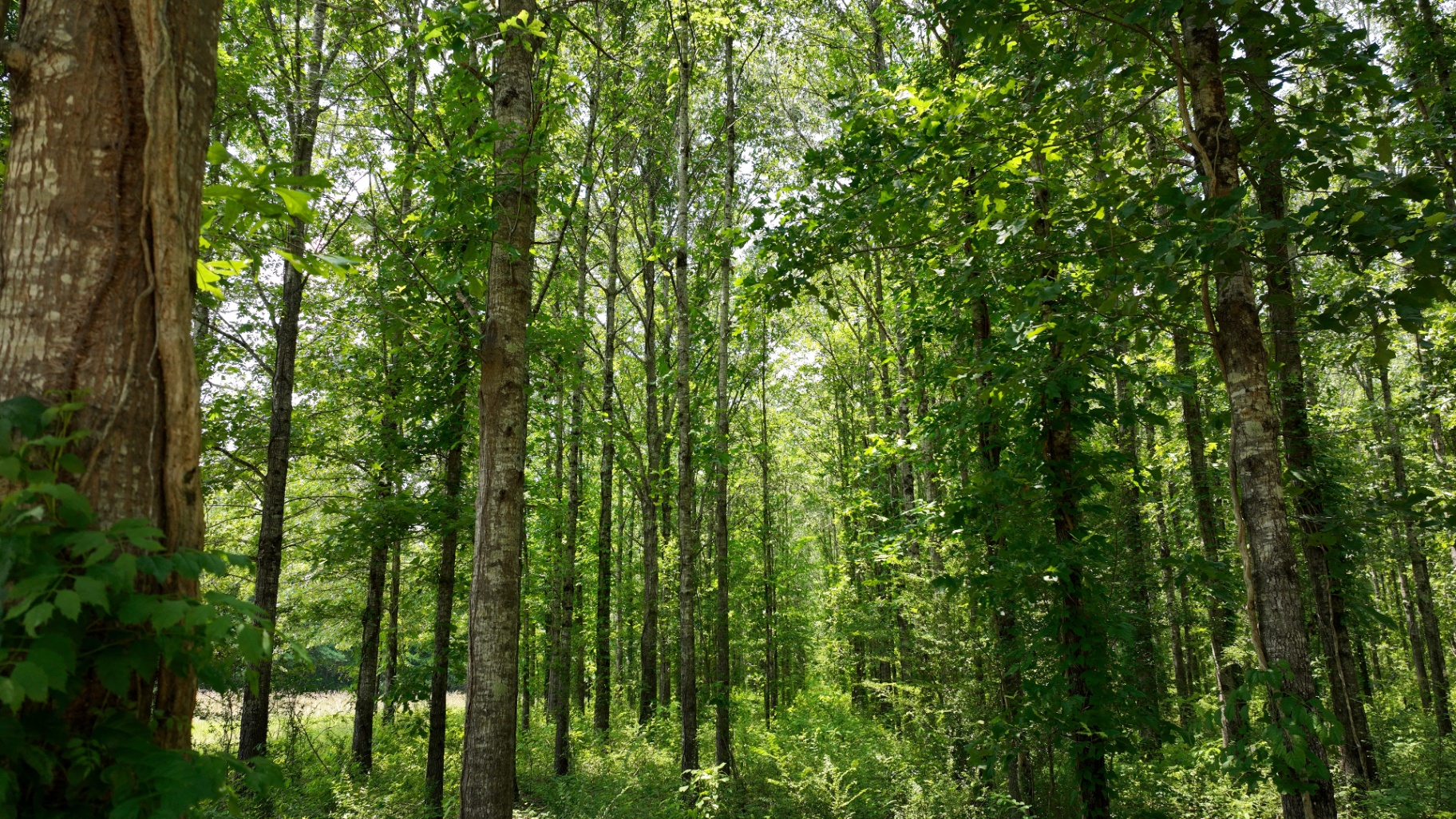
Dallas County spreads along the Alabama River around Selma. Planted pine holds the hilly uplands, but the bottomland hardwood here is a bigger part of the picture than in most counties we work.
Southeast Forestlands works only for the landowner. We do not buy timber and we are not paid by mills.
A Large, Well Timbered County
This is one of the biggest counties we cover and it carries a lot of forest land.
Forest inventory estimates put loblolly as the largest single type, with a bottomland share well above the pine counties north of it.
Real Bottomland Hardwood
Inventory estimates put oak, gum, and cypress at close to a fifth of the forest land, along the Alabama River and its sloughs.
That is a hardwood asset in its own right, and it needs to be graded rather than bundled with pine.
Heavy Clay, Frequent Water
Leeper silty clay and similar soils fall in a frequent flood class. Mapping puts nearly a third of the county in the slowest-draining group.
When that clay is wet, nothing moves on it. Season planning is not optional here.
Hilly Uplands
The Luverne and Troup associations run hilly, mapped near twenty percent slope in places.
Those uplands are where the planted pine sits and where the workable winter days are.
Planting Bottomland Back
Old fields in the bottoms can be put back into hardwood, and that is often a better fit than forcing pine onto wet ground.
It is slow. It also matches what the site actually wants to grow.
Nearby Counties
We also work with landowners in nearby counties, including Perry (AL), Wilcox (AL), and Marengo (AL).
General Guidance
For more on how we handle each part of the work, start with these guides:
- What a timber cruise measures
- How a sealed-bid timber sale works
- How we sell timber
- Wet-weather logging and BMPs
- Thinning decisions
- Regeneration and replanting
- All forestry services
Talk It Over First
Talk with a forester before deciding anything. Contact us to discuss your goals; the first review of your property generally happens online.