
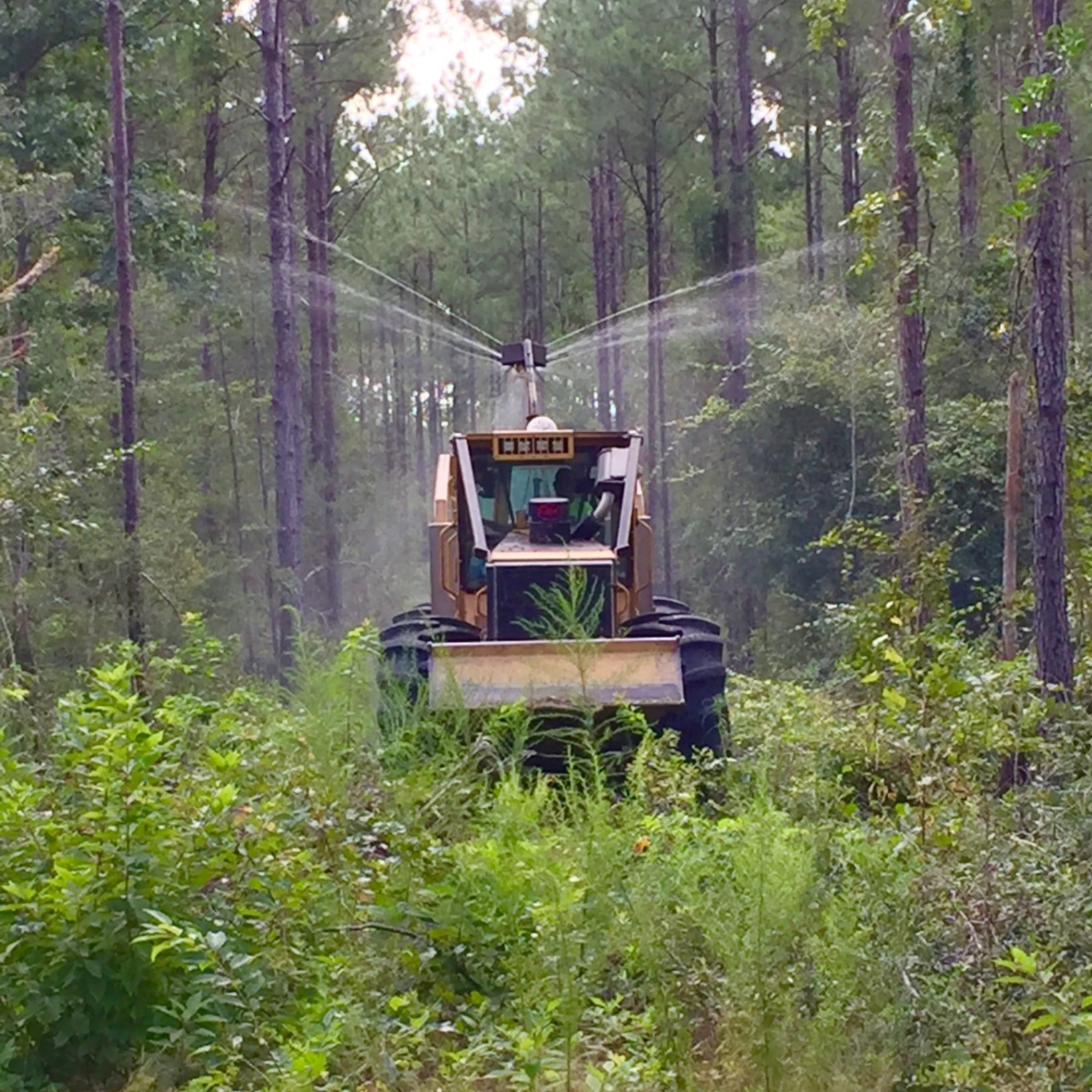
Timber stand improvement (TSI) is one of the most undersold practices in southern forestry. It doesn't write a check the way a thinning or a final harvest does, and that's why landowners skip it. But on the right stand, TSI is the difference between a tract that hits its growth potential and one that limps to harvest with grade and volume left on the table.
This Field Note covers what TSI actually is on Mississippi and Alabama timberland, the conditions where it pays, the cost-share that supports it, and the situations where TSI is honestly not worth the money.
What Counts as TSI
TSI is any practice that improves the future merchantable value of a forest stand without generating immediate merchantable income. The practical forms in our region:
Release Cuts
Removal of competing vegetation — hardwood sprouts, vines, herbaceous competition — that is suppressing crop tree growth. Most common in the first 1–4 years after planting on cutover sites, and in young pine plantations where hardwood competition has reestablished.
Precommercial Thinning
Removal of excess stems in overstocked young stands — typically natural pine regeneration or seeded sites — before any of the trees are merchantable. Reduces competition and concentrates growth on selected stems.
Hardwood Midstory Removal
Removal of the hardwood midstory layer in pine stands using basal-bark herbicide, foliar herbicide, hack-and-squirt, or cut-stump treatment. Reduces competition for moisture, improves understory access for prescribed fire, and clears the way for longleaf restoration where applicable.
Crop Tree Release in Hardwood Stands
Removal of overtopping or side-competing trees from selected hardwood crop trees — usually oak, sweetgum, yellow-poplar, or cherrybark oak depending on the stand. Concentrates growth on the trees that will be the merchantable stand in 20–40 years.
When TSI Actually Pays
TSI economics are time-driven. The treatment costs money today; the return shows up over the years between treatment and harvest. The conditions that drive positive return:
- Long remaining rotation. 15+ years between treatment and harvest gives the growth response time to compound.
- Genuine competition. Stands actually being suppressed by undesirable vegetation respond. Stands that already have free-growing crop trees do not.
- Quality crop trees. Releasing a stand of poor-form, low-grade crop trees doesn't improve much. Releasing well-formed, well-spaced crop trees can dramatically change the final cruise.
- Cost-share. NRCS EQIP cost-share — see EQIP for forest landowners — shifts the economics decisively in favor of the practice on eligible stands.
When TSI Doesn't Pay
TSI is not always the right call. The honest cases where it doesn't pay:
- Short remaining rotation. A stand within 5 years of harvest rarely produces enough growth response to pay the TSI bill.
- Poor crop tree quality. No amount of release improves a stand that lacks the genetic and form quality to respond.
- Wrong stand structure. An overstocked mature stand needs commercial thinning, not TSI. TSI is for stands where no merchantable thinning is yet possible.
- No cost-share and tight budget. On marginal sites without cost-share support, full-cost TSI sometimes doesn't pencil out.
Cost-Share Programs That Cover TSI
NRCS practice codes that cost-share TSI work on Mississippi and Alabama tracts:
- 666 — Forest Stand Improvement. The primary practice code for mid-rotation hardwood midstory removal, crop tree release, and similar work.
- 314 — Brush Management. Covers herbicide treatment of woody competition.
- 315 — Herbaceous Weed Control. Covers herbaceous release in young stands.
- 612 — Tree/Shrub Establishment. The practice that includes site prep and first-year release for new plantings.
An approved forestry management plan is the foundation for ranking any of these practices.
TSI on Specific Stand Types
Young Loblolly Plantation
First-year herbaceous release on cutover plantings is the highest-return TSI practice in southern forestry. Three years of free growth at the start of the rotation compounds into the rest of the stand's life. Skip it and even a well-planted stand limps to first thin.
Mid-Rotation Loblolly
Hardwood midstory removal between first and second thinning improves moisture availability, reduces beetle hazard, and prepares the stand for a burn rotation. Common cost-share candidate.
Longleaf Restoration
TSI is built into longleaf restoration on cutover loblolly sites — site prep, release, burn maintenance. Without TSI, longleaf restoration usually fails.
Hardwood Stands
Crop tree release on bottomland hardwood stands and upland mixed-hardwood stands across central and east Mississippi and west Alabama can be transformative, but stand-by-stand assessment is non-negotiable. Hardwood TSI is more sensitive to species composition and crop tree quality than pine TSI is.
Real-World Pattern
A common situation: a Newton County loblolly plantation, age 12, planted on a cutover with no first-year release. Hardwood competition has reached into the lower canopy. The stand is 3–4 years behind its growth curve. A mid-rotation TSI prescription — basal-bark herbicide treatment of competing hardwood stems above 1-inch DBH, with cost-share through NRCS EQIP — costs the landowner a fraction of a free-bid contractor rate. Five years later the first thin still happens on schedule, but the residual stand has visibly recovered diameter growth and the second thin is back on the original calendar. The TSI didn't write a check on the day of the work; it preserved years of growth that would otherwise have been lost.
Where TSI Pays the Most
TSI returns are strongest on the long-rotation working forests of east-central Mississippi (Jasper, Newton, Clarke), the Pine Belt's young plantation acres, and the cutover sites across west Alabama where active management on a 25–35-year rotation makes the early-investment math work. Short-rotation tracts and absentee-managed tracts with no clear long-term plan are where TSI gets skipped — and where the missed growth is hardest to recover.
The Plan Is What Makes TSI Happen
TSI is a calendar practice. Without a written prescription identifying which stands qualify, what treatment they need, and when the cost-share signup window opens, TSI doesn't get done — landowners default to thinning and final harvest because those are the calls that get attention. A working forestry management plan puts TSI on the schedule. Help building that plan and lining up the cost-share is part of our consulting forester practice.