
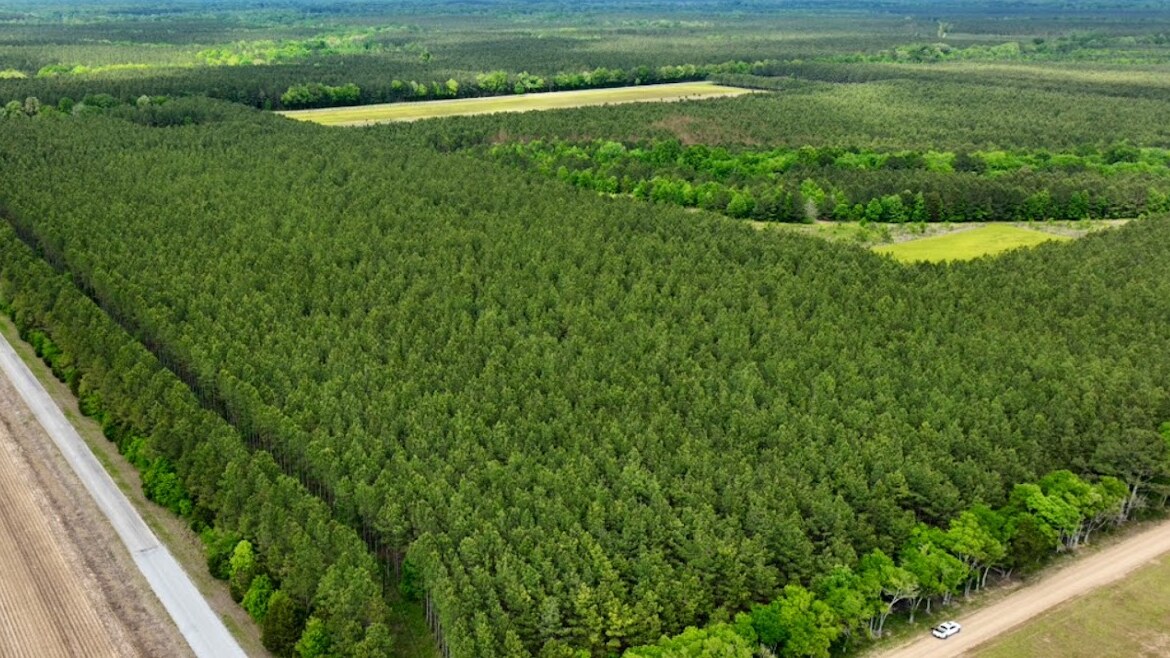
Mobile County is its own market. Deepwater port demand, the Mobile-Tensaw Delta on the east, coastal development pressure pushing out from the city, and a band of working timberland that runs from Citronelle and Wilmer in the north down through Theodore and Grand Bay. The mills, the export docks, and the real-estate buyers all want different things from the same acre, and they rarely agree on what it's worth.
I run Mobile County tracts with all three of those forces priced in — the harvest decision is rarely just a harvest decision here.
Where the Bids Come From in Mobile County
Buyer demand on a Mobile County tract is shaped by the deepwater Mobile port industrial complex, chip and pulp mills inside the metro area, and barge and rail access to specialty buyers. Coastal longleaf pole-quality stems, delta-margin hardwood and cypress, and Coastal Plain loblolly each align with a different bidder subset, and reaching all of them means the cruise has to separate pole material, sawlog, CNS, and pulpwood before any prospectus is circulated.
Evaluating Pole-Grade Classification on a Mobile County Longleaf Stand
Example forestry scenario for local landowners. Consider a longleaf tract north of the city where a walk-up buyer has quoted the stand as sawtimber and pulpwood only. A remeasurement that tracks pole-grade material as its own product class can classify candidate trees against pole specifications for length, taper, sweep, and defect. A sealed-bid prospectus can then invite pole buyers alongside conventional sawtimber and pulpwood buyers, and each qualified response can be compared line-by-line against the cruise. The purpose is to see how the market values pole classification and to compare qualified-buyer responses under a defined contract — not to predict that pole-tracking will produce a higher per-acre figure.
The core insight for this county is straightforward: deepwater port access, urban-fringe harvest constraints, delta-margin ecology, and coastal-development pressure on long-term land value. An unsolicited offer arriving before a cruise has been walked rarely reflects the full product-class picture.
Costly Patterns We See Repeatedly in Mobile County
Most preventable losses on Mobile County sales follow a short, repeatable list:
- harvesting near growing Mobile-area subdivisions without dust, noise, and visual-buffer protections in the contract
- selling delta-margin tracts without a site-specific review of wetland features, stream and drain crossings, BMP requirements, and any applicable federal, state, or local permits that a qualified professional identifies for that tract
- ignoring deepwater-port specialty buyers and selling only to the nearest pine mill
None of these are mysterious. They all come from selling timber without independent representation in a market this specific.
Reading the Ground in Mobile County
Mobile County land sits in the Coastal Alabama, Mobile-Tensaw Delta and Gulf Coastal Plain, anchored around Mobile and communities like Saraland, Citronelle, Mount Vernon, Wilmer. Drainage runs through Mobile Bay, the Mobile River, the Tensaw River, Chickasaw Creek, and the soils are sandy Coastal Plain uplands, broad delta and bottomland flats along the lower rivers, and coastal-influenced soils with higher water tables.
The standing timber reflects that geography: loblolly and longleaf on the uplands, swamp hardwood and cypress in the delta margins, and Coastal Plain mixed pine-hardwood. What grows here is not what grows fifty miles in any direction, and pricing has to follow.
Who We Work For
On a Mobile County tract, urban-fringe access constraints, pole-grade classification, and delta-margin hardwood grading all shift the read on standing volume. When the same party estimates those variables and then bids on the wood, the landowner has no independent check on how pole-quality stems or delta hardwood were sized — and metro-area subdivision buffers and haul-window limits shape which loggers can realistically execute the sale.
Southeast Forestlands does not buy timber, log timber, or take referral fees from buyers or loggers. That separation is what keeps the pole-grade classification, delta hardwood grading, and access assessment answering to the landowner rather than to any mill relationship — see our independent forestry consulting approach.
Urban-Fringe Access and Pole-Classification Planning in Mobile County
Planning for a Mobile County tract may need to account for urban-fringe access, delta-margin wet ground, and a coastal buyer pool that can include pole and specialty markets alongside conventional pine mills. A cruise can describe those conditions and product classes rather than reporting standing volume alone.
A possible consulting scope may include a cruise that identifies pole candidates alongside sawtimber, CNS, and pulpwood; a prospectus inviting deepwater-port and pole-market buyers along with the regional pine pool; contract terms for urban-fringe haul routing, wet-ground restrictions, and buffer handling; and oversight during the harvest.
Cross-County Coordination
Mill draws, buyer participation, and haul economics in Mobile County can extend across county lines into Washington County and Baldwin County. If you own land in more than one of those counties, coordinating multiple tracts may broaden the qualified buyer pool when timing, products, and haul geography align.
Sale Timelines and What to Expect
An early conversation — before an unsolicited buyer has framed the decision — gives a Mobile County landowner room to evaluate pole-grade potential, delta-margin grading, and urban-fringe access separately. That framing matters whether the tract is an inherited coastal parcel, a Coastal Plain upland stand near Citronelle or Wilmer, or a delta-adjacent property being reassessed for the first time in years.
The cruise-to-closing window on a Mobile County tract depends on how carefully the pole material, delta hardwood, and urban-fringe access terms are separated in the prospectus and contract. Compressing that timeline can cost more than it saves. Between rotations, modest stand improvement work on the upland pine is often the highest-return spending a Mobile County owner can do.
Start the Conversation
If you own timberland in Mobile County, Alabama, the first step is a conversation — no obligation, no buyer in the room, and an honest read on whether selling, holding, or managing makes more sense for your situation.
Contact Southeast Forestlands to start that conversation, or read more about our independent forestry consulting services.
About Mobile County, Alabama for Timberland Owners
Mobile County, Alabama centers on Mobile and is reached by I-10, I-65, US 90, and US 98, with timber moving through the Mobile, Chickasaw, and Bay-area pulp, sawtimber, and export markets. Drainage follows the Mobile, Tensaw, and Dog rivers and the Mobile-Tensaw Delta, and most working timberland is loblolly and slash pine plantations on the uplands with hardwood and cypress through the delta.
Mobile County timberland is one storm season away from being a different kind of asset. The salvage clock starts the day the wind stops, the wetland overlay decides which loggers can get to which ground, and the deepwater port keeps a buyer pool nobody inland has access to. The owners who do well here keep a current cruise on file, keep boundaries painted, and pick up the phone before a single load moves — not after. The first call is the one that decides what the salvage is actually worth.

