Herbicide timing makes or breaks the chemical site prep and release work that drives a southern pine plantation's first decade. The same product applied in the wrong window can do half the work, none of the work, or — at the extreme — damage the stand. Getting the timing right is what separates a successful chemical treatment from a wasted invoice.
This Field Note covers the practical herbicide timing windows for southern pine site prep and release in Mississippi and Alabama, the differences by product class, and the field calls that determine whether the application accomplishes its objective.
The Three Standard Treatment Windows
Site Prep — Late Summer to Early Fall
For cutover sites scheduled for winter planting, the standard chemical site prep window in Mississippi and Alabama runs roughly August through October. Three reasons:
- Hardwood sprouts are still actively translocating photosynthate to roots before dormancy — moving herbicide into the root system rather than just defoliating the top.
- Herbaceous competition is still alive and treatable.
- The treatment has time to take effect before winter planting, leaving a competition-suppressed site for the pine seedlings.
Spring or summer site prep is sometimes used when the harvest schedule doesn't fit fall application, but the woody-control effectiveness is generally lower outside the late-summer-to-fall window.
First-Year Herbaceous Release — Early Spring
Newly planted pine seedlings benefit most from herbaceous competition control in the first growing season. The window is early spring of the planting year, typically March through early May in our region — before the herbaceous competition peaks and starts shading and dewatering the seedlings. Done correctly, first-year release produces a survival and growth response that compounds for the rest of the rotation.
Woody Release in Established Young Stands — Summer to Fall
For young plantations where hardwood competition has reestablished and is competing in the canopy, woody release herbicide treatments typically run summer through fall — late June through October depending on the product. Treatment after canopy closure on the hardwood targets but before full leaf abscission is the active period.
Product Class Considerations
Different herbicide chemistries have different timing windows. Without naming specific products, the categories that drive timing:
- Triazine-class soil-active residual herbicides — applied to bare soil or low-cover sites, typically prior to or at planting.
- Foliar-active translocated herbicides for woody control — require active foliage, dictating late-summer-to-fall application for best translocation.
- Sulfonylurea-class herbicides — used for herbaceous and some woody control with site-specific windows.
- Imidazolinone-class herbicides — common in pine release with specific windows around active growth periods.
The label is the law on which product goes down when, at what rate, and under what conditions. A licensed applicator working off the label is the standard of care.
Rate by Objective
Herbicide rate isn't a "more is better" decision. Three common rate-setting objectives:
- Suppression vs. kill. Suppression rates knock back competition without eliminating it; kill rates are required when full removal of the competing species is the objective.
- Species selectivity. Rate and product selection adjust based on the dominant competing species on the site — sweetgum, oak, blackjack, gallberry, hardwood vines all have different sensitivity profiles.
- Crop safety. Pine release rates must stay within the safety window for the pine, which is product-, age-, and condition-dependent.
Higher rates aren't always more effective and can compromise pine safety. Lower rates fail to achieve the objective. Rate selection is a per-stand professional call, not a default number.
Field Conditions That Affect Application
The treatment window can be open and the application still go badly:
- Wind. Aerial application requires wind within label limits, with drift to non-target areas a constant constraint near streams, neighboring crops, and sensitive areas.
- Temperature. Most foliar herbicides have temperature ranges for application; very hot or very cool conditions can reduce efficacy or increase crop injury.
- Rainfall. Most foliar herbicides require a rain-free window after application to allow translocation. Heavy rain shortly after application washes off active ingredient.
- Moisture stress. Drought-stressed competition translocates less herbicide and is less susceptible to treatment.
Aerial vs. Ground Application
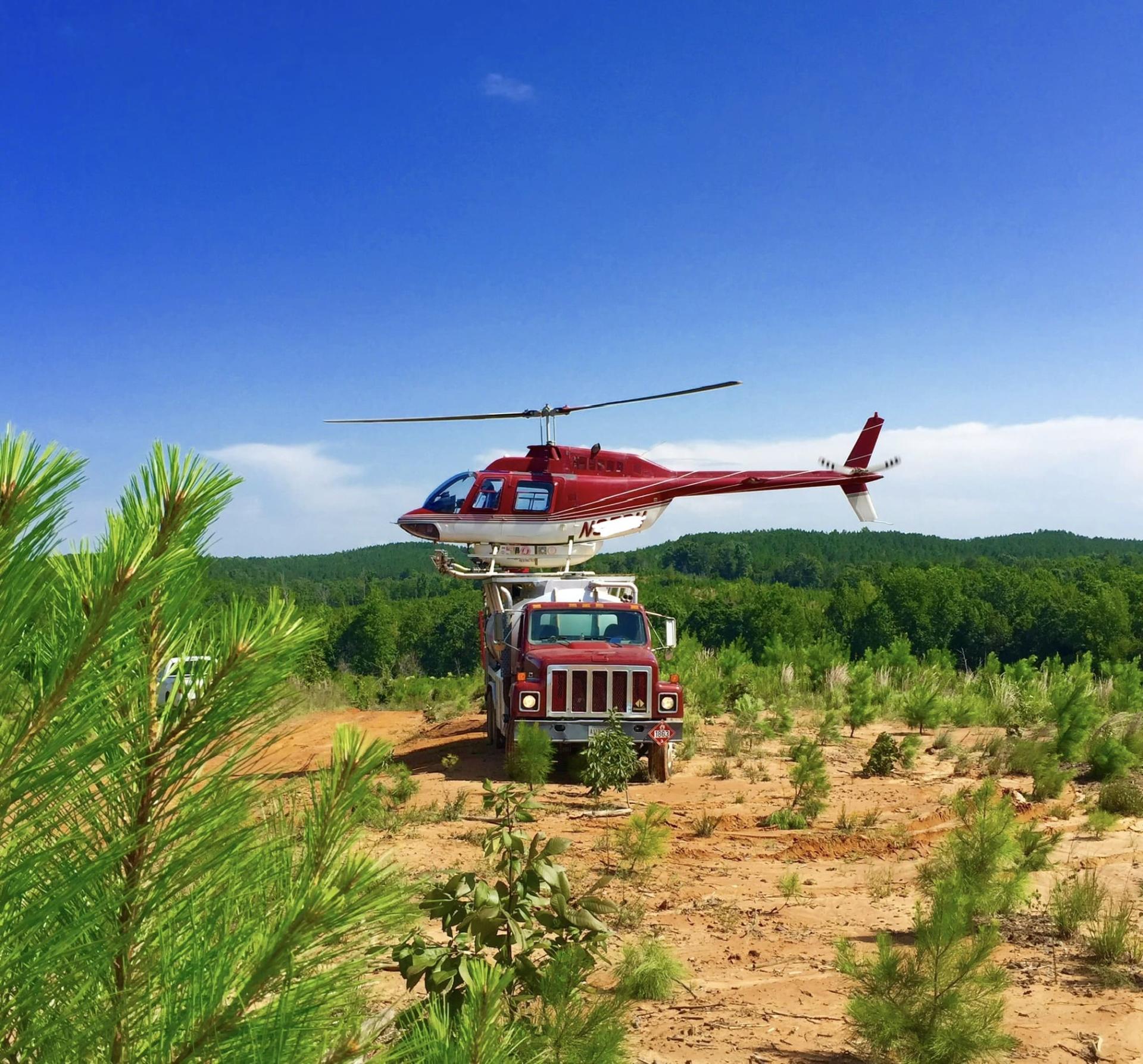
Most large-tract site prep and release in Mississippi and Alabama is aerially applied — helicopter or fixed-wing — because the speed, ground coverage, and ability to treat ground that equipment can't access drives the economics. Ground application by backpack, skidder-mounted boom, or ATV-mounted sprayer fits smaller tracts, sensitive zones, and stands where targeted treatment (basal-bark, cut-stump, hack-and-squirt) is the prescription.
Cost-Share Support
NRCS EQIP cost-shares herbicide treatments under several practice codes:
- 314 — Brush Management: covers woody competition control.
- 315 — Herbaceous Weed Control: covers herbaceous release in young stands.
- 612 — Tree/Shrub Establishment: bundles site prep, planting, and first-year release.
- 666 — Forest Stand Improvement: covers mid-rotation chemical TSI on established stands.
Eligibility, ranking, and rates vary by signup year. Coordinating the herbicide treatment with the cost-share signup window is part of how landowners offset the cost — see EQIP for forest landowners for the program detail.
Real-World Pattern
Common scenario: a cutover loblolly tract in Covington County, harvested in spring, scheduled for winter planting. A fall (September–October) site prep application of a labeled, properly selected foliar herbicide mix knocks back the woody sprout regrowth and the herbaceous cover. Seedlings go in during January–February. A first-year herbaceous release spray follows in early April. The combination produces a planted stand that closes canopy 1–2 years earlier than the unsprayed alternative, with documented survival and growth advantages that show up at the first cruise. Total chemical investment is a small share of the rotation, partially cost-shared.
Where Herbicide Treatments Are Most Common
Cutover loblolly planting across the Pine Belt — Jones, Forrest, Covington, Jefferson Davis — and across west and central Alabama is where the bulk of southern pine herbicide work goes down. Longleaf restoration sites have their own herbicide prescriptions overlapping with the windows above; see longleaf restoration on a cutover loblolly site.
The Timing Call Is the Professional Call
Herbicide work is one of the practices where missing the window by a few weeks can mean spending the same money for half the result. Lining up the prescription, the product, the contractor, the weather, and the cost-share signup is what makes the application actually work — and is part of the silvicultural planning covered by our Mississippi consulting forester practice and tied to the forestry management plan.