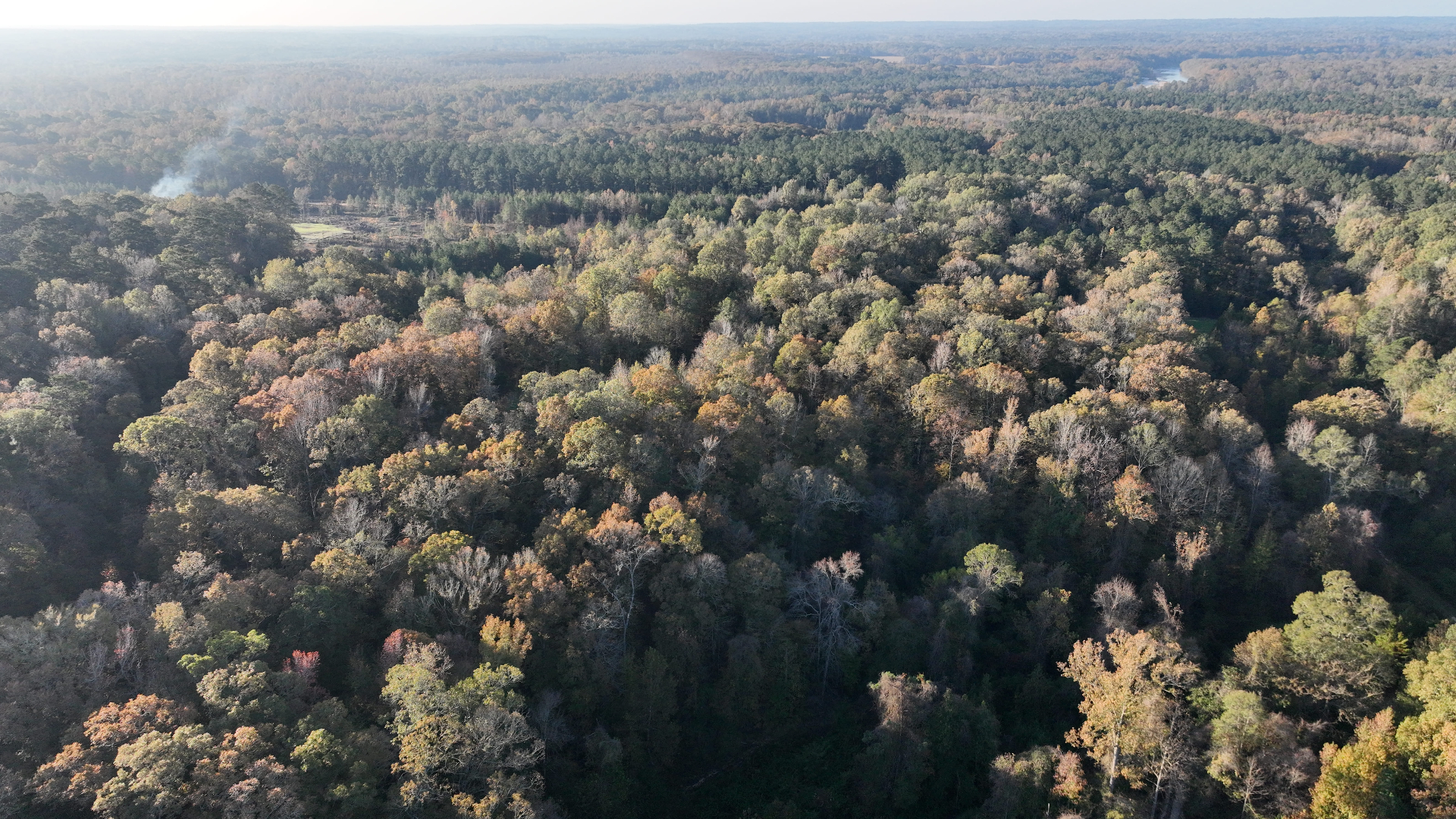
Wilkinson County occupies the southwest corner of Mississippi at the Louisiana line, sitting between the Homochitto National Forest and the river. Tracts here often run larger than the regional average, and the mix of Citronelle uplands, loess slopes, and Buffalo and Homochitto bottomland hardwood generally makes the cruise and the marketing more nuanced than on a straight pine tract.
Cruising Wilkinson County’s Different Timber Types
Most Wilkinson ownerships include loblolly plantations on the Citronelle uplands, mixed pine-hardwood on the loess slopes, and rich bottomland hardwood along the Buffalo and the Homochitto. Those components can behave as separate stands from a marketing standpoint. Pine buyers competing on pulpwood, CNS, and pine sawtimber often price the uplands aggressively but may not evaluate grade hardwood carefully; specialty hardwood buyers can bid the bottoms on stem-by-stem grade but rarely bid the pine at all.
A single averaged cruise can leave the hardwood component priced against a pine reference and undercount the actual grade in the bottoms. Breaking the cruise by cover type and marketing the pine and hardwood as distinct product lines within the same bid package is generally the way to keep both sides honest.
Educational scenario — a mixed-stand marketing question. Consider a hypothetical Wilkinson County tract with a Citronelle upland pine plantation, a loess-slope mixed stand, and a Buffalo River bottomland hardwood component. Presented here as an educational planning example — not as a completed Southeast Forestlands project — the useful exercise is to cruise the bottoms separately, describe the hardwood grade on its own terms, and consider whether a sealed-bid process that lists the components as separately biddable can invite qualified buyers who might not otherwise engage with the tract. The intent is to make sure each product class is actually evaluated by buyers who compete for it.
National-Forest-Line Planning Before a Harvest
A meaningful share of Wilkinson County timberland shares a line with the Homochitto National Forest or with absentee neighbors and out-of-state heirs. Both situations create practical questions before a harvest: where the line actually is on the ground, who is responsible for maintenance and access along the fence, and what a forest-service neighbor may expect on buffer and haul-route conditions.
A written management plan that documents boundary condition, access, and buffer expectations before a sale generally handles those questions on a schedule rather than during a shutdown. Boundary lines that have not been painted in a generation can often be re-established as part of the pre-sale cruise rather than left for the operator to guess at.
Haul Math Across the Louisiana Line
The county FAQ notes that pulpwood, CNS, and pine sawtimber may move into the Crosby, Natchez, Bogalusa LA, and Hammond LA mill corridor, while grade hardwood from the Buffalo and Homochitto bottoms can pull separate premium buyers. Those destinations sit at different haul distances from different corners of the county, and the delivered-cost math can shift meaningfully from one route to another.
A bid package that provides realistic haul-mile estimates from multiple mills — rather than an implicit assumption that everyone hauls to the same yard — tends to invite more considered bidding and can widen the pool of buyers willing to price the tract seriously.
Second Rotation on Citronelle Uplands
Post-harvest planning on Wilkinson uplands often runs into site-preparation questions that trace back to the underlying soils. Sandy Citronelle ridges can respond differently to site prep than the loess slopes on the same tract, and a uniform prescription across both may leave the next stand under- or over-invested in places. Pairing reforestation planning with the actual site — and keeping timber stand improvement on the schedule for the years after planting — is generally where the second rotation is set up.
Starting a Wilkinson County Conversation
For most Wilkinson County owners, the useful starting point is a walked cruise across the compartments, a boundary check where the lines are uncertain, and an honest look at whether the current stand is closer to a thinning, a final harvest, or a longer hold. From there, an independent timber sale can be designed against the actual stand data rather than a walk-up offer.
Southeast Forestlands does not buy timber, log timber, or take referral fees from buyers or loggers. Contact Southeast Forestlands to start the conversation, or read more about our independent forestry consulting services.
Nearby Counties and Timber Markets
Mill draws, buyer participation, and haul economics in Wilkinson County often reach across county lines into Adams County, Amite County, and Franklin County. For landowners with ground in more than one of those counties, a single coordinated marketing package can generally outperform separate sales.
About Wilkinson County, Mississippi for Timberland Owners
Wilkinson County, Mississippi centers on Woodville and sits in the southwest corner of the state at the Louisiana line, between the Homochitto National Forest and the river. Wilkinson County tracts often run from managed loblolly plantations on the Citronelle uplands to mixed pine-hardwood on the loess slopes and rich bottomland hardwood along the Buffalo and Homochitto. Pulpwood, CNS, and pine sawtimber generally move into the Crosby, Natchez, Bogalusa LA, and Hammond LA mill corridor; grade hardwood from the Buffalo and Homochitto bottoms can pull separate premium buyers.
For landowners managing tracts here, the practical issues that tend to recur are national-forest-line management, separating grade hardwood from pine, and cross-state buyer marketing into Louisiana. Decisions on thinning timing, sale structure, and reforestation are generally made with those local conditions in mind rather than from a generic regional template.
Considering Seasonal Access on Larger Tracts
Larger Wilkinson tracts often cannot be cleanly cut, hauled, and cleaned up in a single season. A written schedule that lays out which compartments are harvested when — accounting for wet-weather windows on the bottom components, road and bridge condition on the access route, and reforestation timing on the compartments already cut — generally reduces on-the-ground surprises during the operation. That schedule belongs in the pre-sale package rather than in a mid-project conversation with the operator.

