
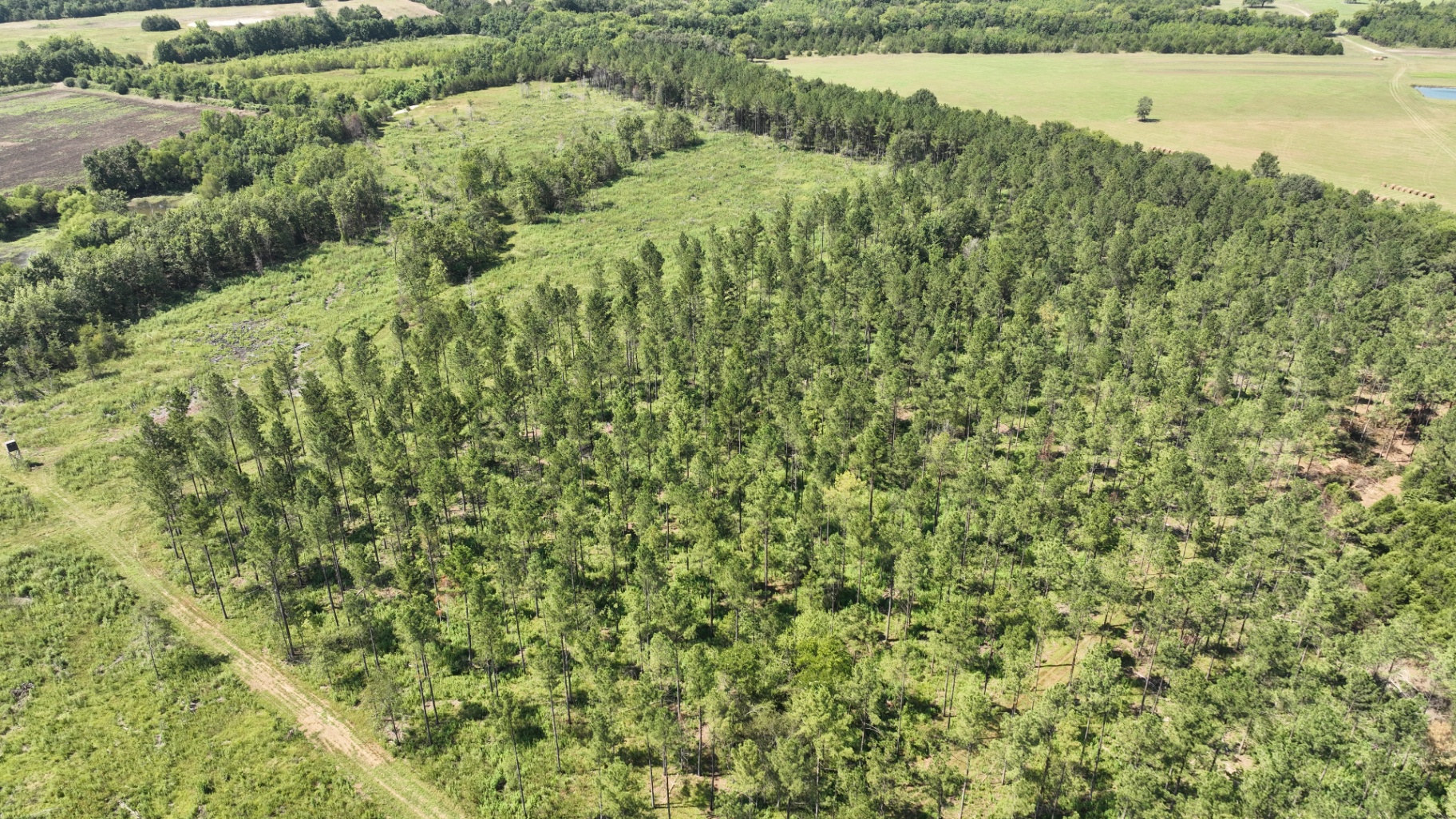
Most lost value in a Mississippi or Alabama pine plantation is locked in years before first thinning. By the time the timber buyer walks the stand, the spacing decision, the fertilizer call, the burn schedule, and the missed thinning window are already paid for. The landowner just hasn't seen the bill yet.
This Field Note covers the recurring plantation mistakes that quietly drain value from southern pine tracts — the ones a registered forester sees on the cruise and a buyer prices into the bid without ever saying so out loud.
Mistake 1: Spacing That Doesn't Match the Objective
The most common spacing mistake is using one spacing for every objective. Tight spacings (7x9 to 8x10) push early canopy closure, suppress competing vegetation, and produce smaller-diameter, straighter trees — fine for pulpwood-driven rotations but a problem if the goal is sawtimber and poles. Wide spacings (11x11 to 12x12) produce larger diameters and heavier limb development, with grade loss in the butt log.
Across the Pine Belt and west Alabama, 9x10 to 10x10 is now the practical default for an integrated sawtimber rotation. First and second thinning remove the competition; final harvest captures the diameter response.
Mistake 2: Planting Genetically Inferior Stock
Improved loblolly families now outproduce unimproved stock by significant margins in growth and form across the southern coastal plain. The seedling cost difference is small. Planting whatever was cheapest at the nursery — or saving seed off a neighbor's tract — locks in 25+ years of suboptimal growth.
Mistake 3: No Site Prep on a Cutover
Replanting a cutover loblolly site without competing-vegetation control is one of the most expensive mistakes a landowner makes. Hardwood sprouts and herbaceous competition shade out and starve newly planted pine for the first three years — the years that decide whether the plantation closes canopy on time or limps along for a decade. Operational chemical site prep is normally the lowest-cost intervention with the highest first-rotation return.
Mistake 4: Treating Fertilization as Routine
Operational fertilization at planting rarely pays in southern pine. Mid-rotation fertilization — usually urea or urea plus diammonium phosphate on diagnosed phosphorus-deficient sites between first and second thinning — produces the documented growth response that shows up in the next cruise. Doing it routinely on every stand wastes money; not doing it on a clearly P-deficient stand leaves growth on the table.
Mistake 5: Skipping the First Thinning Window
This is the single most damaging plantation mistake in our service area. A loblolly plantation that hits prescribed first-thinning basal area (typically around 120 sq ft/acre on most Mississippi and Alabama sites, depending on site index) and isn't thinned within 1–3 years of that signal will:
- Lose diameter growth across the entire residual stand.
- Build southern pine beetle hazard — overstocked stands are where SPB outbreaks start.
- Push trees down a crown class, which sticks for the rest of the rotation.
- Produce a thinner, weaker-rooted residual that's more storm-vulnerable.
The fix is not "thin harder later." Once crown class is lost, it doesn't come back. The fix is hitting the window.
Mistake 6: Wrong Thinning Method at First Thin
The two practical first-thinning methods in the South are fifth-row removal with selection between, and operator's-choice selection. Fifth-row plus selection is the dominant method on planted loblolly because it gives the equipment a clean rack and lets the marker pull the worst-form, lowest-crown-class trees between rows. Pure operator's-choice selection on dense unthinned plantations almost always produces a residual stand the landowner regrets.
Mistake 7: No Burn Rotation
An unburned plantation accumulates hardwood midstory that competes for moisture, drives up beetle hazard, complicates harvest, and shows up as lower grade at final cut. A simple dormant-season burn rotation post-canopy-closure — typically every 2–4 years — costs little, qualifies for cost-share, and changes the cruise number a decade later. Timing rules are covered in prescribed burning timing in Mississippi and Alabama.
Mistake 8: Selling at the Wrong Point on the Cycle
Plantations are sometimes thinned, fertilized, and burned correctly — and then sold into a soft market because the landowner needed cash at a particular date. Reading a timber price report and timing the bid window when possible is part of capturing the value the silviculture earned.
Real-World Example
A common Mississippi pattern: a tract planted in the early 2000s at 8x10 spacing, never burned, never fertilized, and not thinned until age 19 — three to five years past the recommended window. The cruise at age 19 shows a stand stuck around 7-inch DBH where comparable managed stands carry 9–10 inches, with a beetle pocket already active. The first thin still happens, but the diameter response over the next decade never catches the stand up. The landowner does the right thing at first thin; it's the missed window and the missing burns that cost the rotation.
Where These Mistakes Show Up Most in Our Service Area
Across the Pine Belt — Jones, Forrest, Covington, Jefferson Davis — and into east-central Mississippi (Newton, Jasper), unthinned and over-stocked plantations are the single most common avoidable loss our cruises identify. The same patterns show up across west and central Alabama loblolly country.
The Fix Is the Plan
None of these mistakes are mysterious. They happen because nobody is tracking the stand against a written prescription. A forestry management plan with a thinning trigger, a fertilization decision rule, and a burn rotation puts the calendar on someone other than the landowner. The plan is the difference between a stand that hits the cruise number at age 28 and one that loses 20–30% of its potential value to mistakes that were made before the trees were 10 years old. Help building and running that plan is the work covered under our Mississippi consulting forester practice.