
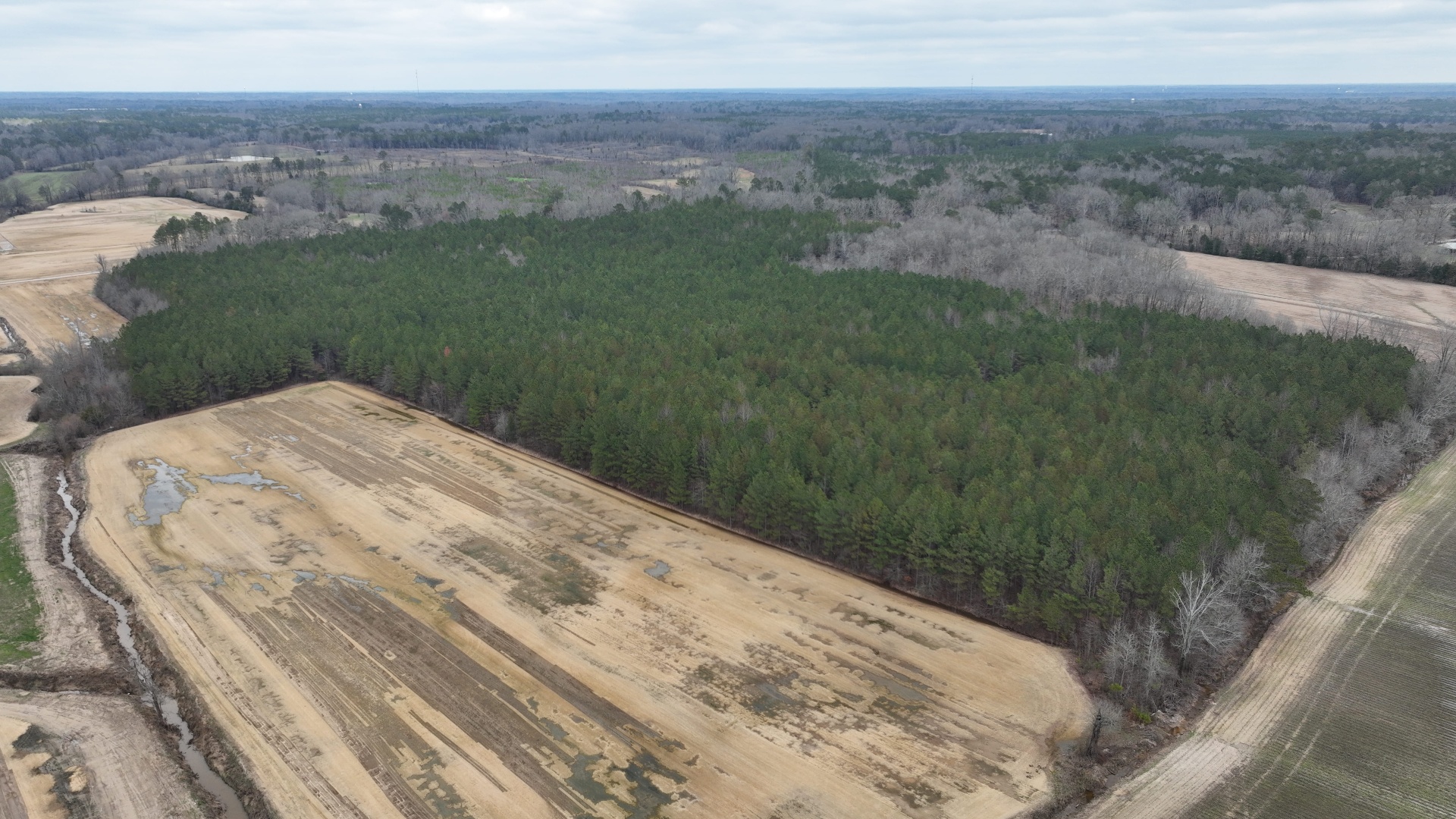
Lee County sits right in the middle of the Tupelo mill pull, and that proximity changes a lot about how timber here trades. Haul distances are short, multiple buyers can reach almost any tract in the county, and even smaller properties around Saltillo, Plantersville, and Shannon can move at solid pricing when the sale is set up to invite real competition rather than just take what walks in.
I work with Lee County landowners on cruises, sale layout, and reforestation. Most ground here is loblolly plantation on rolling terrain, with hardwood drains running into the Town Creek and Tombigbee headwaters — and the practical question on most tracts is whether to thin and hold for sawtimber, sell now while pulpwood demand holds, or build a longer plan around what the stand is actually capable of growing.
What Lee County Timber Actually Looks Like
Lee County land sits in the Tupelo manufacturing belt and Tombigbee headwaters, anchored around Tupelo and communities like Saltillo, Plantersville, Verona, Shannon, Guntown. Drainage runs through the Tombigbee River headwaters, Old Town Creek, Mud Creek, Chiwapa Creek, and the soils are rolling silt loams on the uplands, with broad alluvial flats along Old Town and Mud creeks that hold water into late spring.
Example from the field. Cruised a Lee County tract on the south side of Tupelo where development pressure had already moved within a quarter mile of the line. The owner wanted to harvest before annexation changed the rules. We structured a lump-sum sale with tight access and damage language, ran sealed bids to the regional mill pool, and closed before the next zoning cycle.
The standing timber reflects that geography: loblolly plantations dominate the uplands; bottomland flats carry strong cherrybark, willow oak, swamp chestnut oak, and sweetgum sawtimber. What grows here is not what grows fifty miles in any direction, and pricing has to follow.
Where the Bids Come From in Lee County
Buyer demand on a Lee County tract is shaped by Tupelo's furniture industry hardwood demand, multiple chip-n-saw and pulp mills inside an hour's haul, and pole and pallet specialty buyers throughout the metro. The narrow point is that no single buyer wants every product class — and the wide spread between the lowest and the highest qualified bid is exactly where most landowners lose money.
The core insight for this county is straightforward: the unusually short haul to multiple competing mills, which only translates into top stumpage when every relevant buyer is actually invited to bid. A direct, walk-up offer almost never reflects that reality.
Where Lee County Landowners Leak Value
Most preventable losses on Lee County sales follow a short, repeatable list:
- selling to the first walk-up buyer when six others are within 30 miles
- letting bottomland cherrybark and swamp chestnut oak be priced as gum-grade pulp
- no contract-side protection on tracts near growing Tupelo subdivisions where dust, noise, and road damage become litigation risks
None of these are mysterious. They all come from selling timber without independent representation in a market this specific.
Independence Is the Product
The structural problem in most timber transactions is that the person valuing the timber is also the person buying it. On a Lee County tract, with the specific buyer mix described above, that conflict is worth real money — typically the difference between the floor and the top bid in a properly run competitive sale.
Southeast Forestlands does not buy timber, log timber, or take referral fees from buyers or loggers. That independence is the entire product.
Services on a Lee County Tract
On a Lee County engagement, the work is concrete:
- tract inventory, stand mapping, and product-class segregation across the rolling silt loams on the uplands and bottomland zones
- independent timber sale design — bid package, buyer invite list, and exposure window calibrated to Tupelo's furniture industry hardwood demand and the wider regional pool
- contract terms that protect the residual stand, the road system, riparian buffers along the Tombigbee River headwaters, and payment timing
- on-the-ground harvest supervision and post-harvest inspection
- reforestation, Prescribed Burning, and Timber Stand Improvement planning for the next rotation
You receive an independent set of eyes on every step — paid by you, working for you, with no buyer relationship in the background.
When in the Process Should You Bring in a Forester?
The right time to call is not when a buyer knocks. By then, the negotiating position has already narrowed. The right time is when you are first thinking about the property — whether that is a planned harvest, an inherited tract near Tupelo, a tract you have not visited in a decade, or a question about whether to harvest at all.
Tracts in Lee County typically run a 60-to-120 day cycle from cruise to closing when the sale is structured for real bidding. Compressing that timeline almost always costs more than it saves.
If You Own Land in More Than One County
Mill draws, buyer participation, and haul economics in Lee County routinely cross county lines into Pontotoc County, Union County, Prentiss County, Itawamba County and Monroe County. If you own land in more than one of those counties, a single coordinated marketing package usually outperforms separate sales.
Getting Started in Lee County
If you own timber in Lee County and want a straight read on what the property is carrying — and how the Tupelo-area mill pool will actually price it — the first step is a walk-through and a conversation.
Contact Southeast Forestlands to talk through your tract, your goals, and your options.