
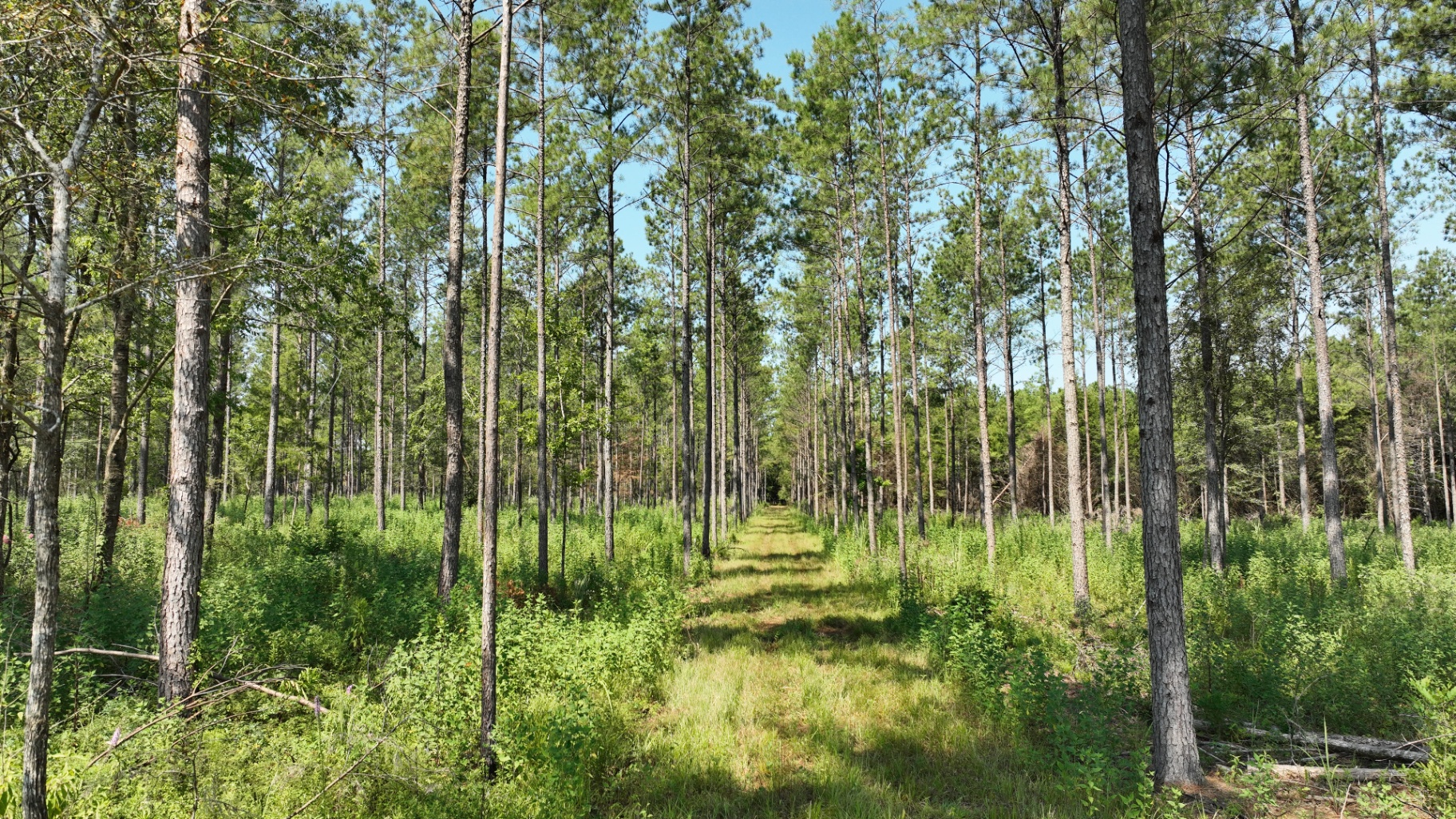
Pine Belt stumpage prices move in cycles, but the cycle never looks the same twice. Some years the price report tells the same story as the local mill yard; some years it doesn't. The landowner's question — wait or sell — comes down to combining the regional cycle with the specific stand and the local timber market, not to picking a top or a bottom.
This Field Note covers what actually drives Mississippi Pine Belt stumpage prices, how to read where the market is in its cycle, and the conditions where waiting beats selling — and where selling beats waiting.
What Drives Pine Belt Stumpage
Pine Belt stumpage is local. Five forces set the price in any given local timber market in any given quarter:
- Mill demand. The pulp, sawmill, OSB/panel, and pellet capacity within haul distance of the tract — and how full those mills' yards are this week.
- Standing inventory. The merchantable volume in the shed available to those mills. After a major storm or a wave of clearcuts, regional inventory can shift fast.
- Weather and operability. Wet weather closes operable acres and tightens supply. Dry weather opens supply and softens prices, holding all else constant.
- Storm salvage events. A hurricane or tornado dump can flood a regional market with salvage wood for months, depressing prices for the rest of the local supply.
- National macro signals. Housing starts, repair/remodel activity, pulp and paper demand, and export markets set the long-term trend the local market moves around.
Price by Product Class
Pine sawtimber, chip-n-saw, and pulpwood don't move together. A market where sawmill demand is strong and pulp demand is weak shows premium sawtimber prices and depressed pulpwood — and the inverse a year later. Tracts whose stocking is skewed toward one product class move with that class's local market, not the headline average.
Reading a regional price report is covered in detail in how to read a timber price report.
Cycle Length and Amplitude
Pine Belt stumpage cycles have historically run several years from peak to trough, with cyclical amplitude often in the 20–40% range on individual product classes. Sawtimber tends to lead pulpwood by quarters to years. Mill openings, expansions, and closures create step changes that don't fit the cycle pattern at all — when a major mill comes online or shuts down, the local market resets independent of where the broader cycle was.
When Waiting Makes Sense
Waiting beats selling when:
- The stand still has meaningful growth ahead — every year of growth is value the next sale captures regardless of price.
- The local market is clearly soft, mills are full, and recent comparable sales are below trend.
- The landowner has no liquidity pressure and can carry holding costs.
- Stand condition is good — basal area inside the recommended range, no active beetle pressure, no storm damage.
- A reasonable read suggests local conditions are likely to improve (a planned mill expansion, recovery from a regional event).
When Selling Beats Waiting
Selling makes sense when:
- The stand is overstocked and accruing beetle hazard — waiting risks a runaway loss that no future price recovers.
- The tract is fully mature and growth has slowed; additional time on the stump produces little additional value.
- Local market is at or above trend with active bidder competition.
- The landowner has tax, estate, or liquidity reasons to crystallize the sale.
- A storm or other event has put the stand at risk and the salvage window is open.
The Beetle Trap
One of the most common mistakes in Pine Belt timber management is waiting on price in a stand that is past first thinning and overstocked. The market "feels soft" so the thinning gets pushed. Two summers later a southern pine beetle outbreak takes 20% of the stand at salvage prices. Even if pulpwood prices rebound the following year, the landowner sold the wrong wood at the wrong time. Beetle risk doesn't respect the price cycle.
The Storm Trap
The mirror of the beetle trap is waiting on price in a hurricane-exposed coastal county. The market is soft; the landowner waits. A Gulf storm runs through and the entire stand becomes salvage wood at distressed prices. Salvage sales after storms never recover full pre-storm value. Geography is part of the decision.
Information That Helps
The information that supports a real wait-or-sell decision:
- Regional price reports — TimberMart-South or comparable — for trend context.
- Recent comparable sales in the same county and timber market.
- Local mill intelligence — current intake, recent quoted prices, capacity changes.
- Current cruise of the subject stand, with growth projection.
- Honest assessment of stand condition risk (beetle, storm, fire, regulatory).
A registered forester combines these into a tract-specific recommendation. Nobody calls cycle tops, but you can usually identify "the market is clearly soft and the stand can carry," "the market is normal and the stand is ready," or "the market is acceptable and the stand has risk that argues against waiting."
Real-World Pattern
Common scenario: a Jones County loblolly stand, age 24, well-thinned and well-stocked. Regional sawtimber market is mid-cycle, not at a clear peak. The landowner could clearcut now or wait for a stronger market. The forester runs a growth projection and concludes the stand will accrue meaningful additional sawtimber value over the next 3–5 years; the stand is healthy with low beetle risk; the landowner has no liquidity pressure. Recommendation: wait, with annual check-ins to reassess. Three years later the regional market has moved up, the stand has grown into a larger share of premium sawtimber, and the sealed-bid sale clears at a price that justifies the wait. Decision wasn't a market call — it was a stand-condition call combined with a market read.
Mirror scenario: a Forrest County stand at the same age but visibly overstocked, with no prior thinning. Same market conditions. The forester's call is opposite — sell now in any reasonable market because the stand is on borrowed time for beetle risk and storm exposure. The decision isn't about hitting the market peak; it's about not being on the wrong side of a stand-condition event.
Where the Pine Belt Cycle Hits Hardest
Mill-dense Pine Belt counties — Jones, Forrest, Covington, Jefferson Davis, Lamar — see the most active stumpage markets and the strongest cyclical signal in our service area. Tracts farther from major mill clusters move less, see less competition, and tend to track an averaged price rather than a sharp cycle. Storm-exposed coastal counties like Greene, Perry, and George add hurricane risk to the timing calculation that inland counties don't carry.
The Right Process
Wait-or-sell is not a guess. It's a structured combination of stand condition, regional price data, local mill intelligence, and landowner situation. Help running that process — current cruise, market read, sale strategy, and (when the call is to sell) sealed-bid execution — is the work covered by our Mississippi timber sales and consulting forester practices.
Further Reading and References
For tract-specific decisions tied to the market cycle, see current timber prices in Mississippi, timber appraisals, timber sale representation, and forestry consulting.
Authoritative references: Timber Mart-South regional stumpage reports, USDA Forest Service — Southern Research Station market analysis, and MSU Extension Forestry price-trend material. Written and reviewed by Eric Entrekin, Registered Forester (MS & AL).