
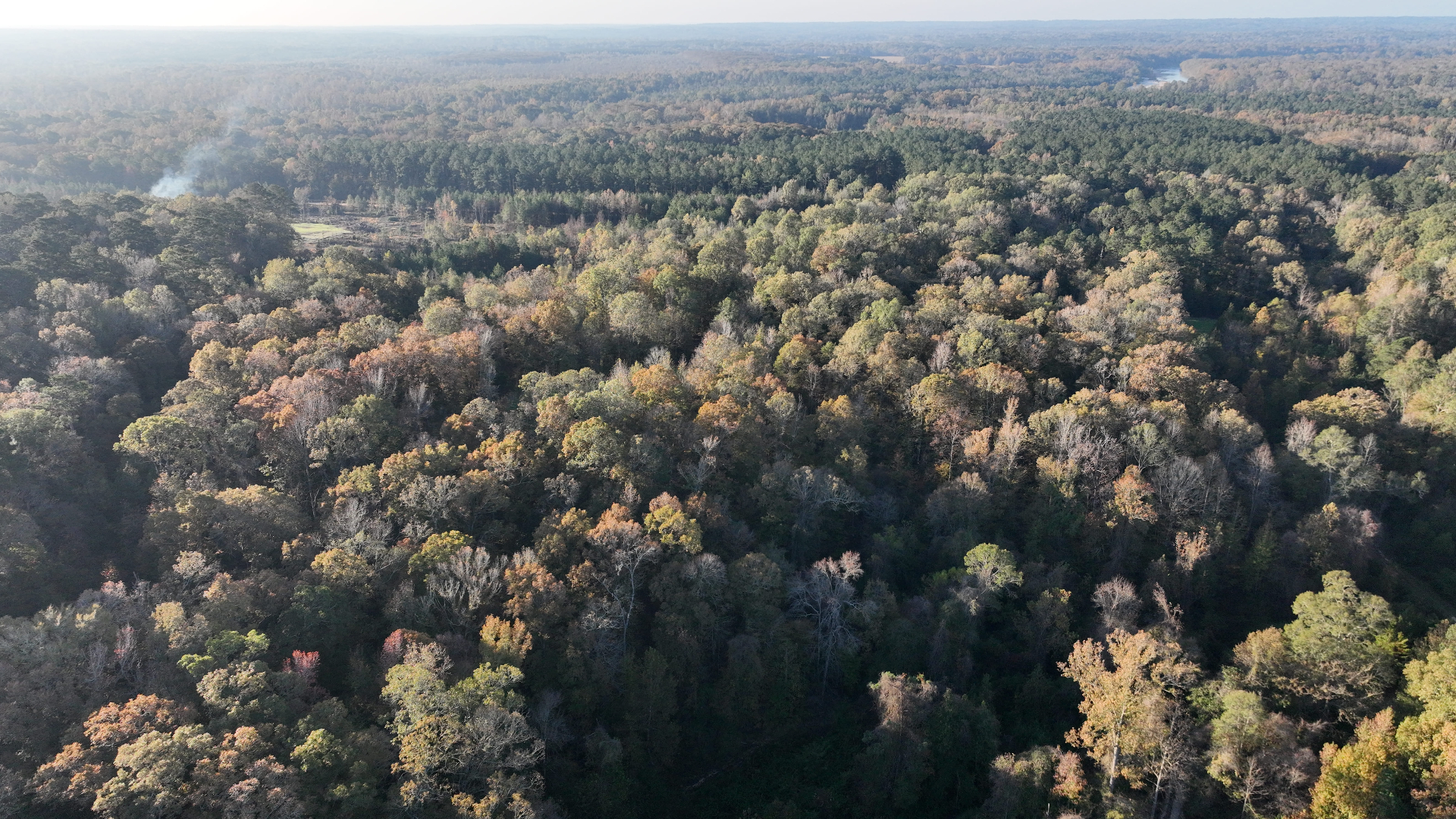
Lawrence County sits in one of the better-positioned pine markets in south Mississippi. The Pearl River cuts through the county and shapes a lot of the bottomland hardwood acreage, while the uplands around Monticello and New Hebron run heavily to loblolly plantation. Haul direction usually points east to Hattiesburg, north to Brookhaven, or south to the McComb cluster.
I work with Lawrence landowners on cruises, sale structuring, and reforestation planning. The recurring question on most tracts here is straightforward — when's the right thinning window, has the stand carried enough sawtimber to justify a final harvest, and what's the property realistically worth if it had to sell this year versus next.
Working Lawrence County Ground: Pearl, Bogue Chitto, and Silver Creek
Three drainages define most of the operability picture in Lawrence County. The Pearl River runs the eastern side and carries the wider bottomland corridor. The Bogue Chitto crosses the southwest with its own hardwood bottoms and streamside zones. Silver Creek cuts through the middle of the county and gathers most of the smaller feeders coming off the loblolly uplands around Monticello and New Hebron.
Those drainages shape where the hardwood volume actually sits, which parts of a tract stay operable through a wet winter, and where streamside management zones need protecting during any harvest. A cruise walked on the ground catches all three; a read from a satellite image usually catches none. The upland loblolly plantations away from the rivers are the volume driver on most Lawrence tracts, and whether that volume trades as pulpwood, chip-n-saw, or sawtimber depends on stocking, thinning history, and how patient the ownership can be with the market window.
The predictable losses without that kind of read are familiar:
- Harvesting before a thinning has compounded value into the sawtimber class.
- Accepting a walk-up price built on the closest mill's convenience.
- Signing contracts that do not spell out road location, wet-weather stop, and SMZ protection.
- Wet-season logging that ruts access lanes and drops the value of the residual stand.
Lawrence County ownership commonly sits somewhere along the arc from Silver Creek and the Bogue Chitto in the southwest to the Pearl River corridor on the east. That range means neighboring tracts inside the same county can face genuinely different operating conditions from one season to the next, and a plan written for one end does not translate cleanly to the other. The county seat at Monticello is a useful mid-point, but the tract-level read is what actually matters.
The Monticello–Brookhaven Mill Cluster and Sale Structure
Lawrence County sits inside one of the healthier pine-market corridors in southwest Mississippi. Pulpwood, chip-n-saw, and sawtimber all move into the Monticello and Brookhaven mill cluster, and the same wood can draw bids east toward Hattiesburg and south toward the McComb area when the sale is structured to invite them. A walk-up offer rarely reflects the top of that pool — the buyer who shows up first has no reason to bid against the buyer who has not been called yet.
A sale that reaches more than one market direction on the same day is generally how the spread between an average bid and the top qualified bid ends up on the landowner's side of the ledger. Pay-as-cut structure with product-class segregation gives buyers a fair set of numbers to bid against and gives the landowner a contract that pays for what actually comes off the tract. On the harvest side, oversight is where a contract stops being paper — road location, weather stop clauses, streamside protection, and residual-stand care get monitored while the job is running, not after.
Independent Representation — What That Looks Like on a Lawrence Tract
Southeast Forestlands does not purchase timber, does not represent mills, and does not take referral fees from loggers. In a mill-dense corner of the state, that independence is the difference between a bid the closest yard is comfortable making and a bid that reflects what the wood is actually worth. Nearby counties like Copiah and Jefferson Davis have their own operability quirks, which is why a template from one county rarely fits the next.
On a Lawrence County engagement, the work is concrete:
- Put a defensible number on the standing timber before any offer is entertained.
- Advise on the right sale window for the specific stand — this year, next year, or later.
- Structure the sale — sealed bid or negotiated — around the tract, not around a template.
- Supervise the harvest against contract terms, in the woods, while the job is running.
- Set the property up for what comes next — replanting, TSI, or a longer growing period toward sawtimber.
Management Plans, Timber Stand Improvement, and Appraisals
Plenty of Lawrence County ownership is not on a sale timeline right now — and for many of those tracts, that is the correct read. A written management plan turns "we own some timber" into a sequence of decisions with a defensible timeline. Most plans end up covering:
- Timber Stand Improvement on upland loblolly carried past the first-thinning window.
- Prescribed burning where fuel loading and understory competition need to be brought back into range.
- Reforestation planning on cutover ground — seedling type, spacing, and site prep matched to the site.
- Access planning that anticipates the next thinning and final harvest.
- A written rotation timeline — with expected thinning windows and product-class shifts — so the ownership can plan tax, estate, and reinvestment decisions around it rather than reacting to a buyer call.
Neighboring Lincoln, Pike, Walthall, and Simpson County ownership often faces similar planning questions, and Lawrence tracts along those county lines often benefit from a plan that acknowledges the shared buyer pool rather than pretending the mill draw stops at the line.
Where a sale is closer to the horizon, an appraisal is the foundation. Our timber appraisals pull species composition, product-class volume, stem quality, and access into a single number calibrated against current Mississippi timber pricing. That number sets a defensible basis on inherited ground before tax decisions are made, supports estate or partnership planning, and gives a landowner a real floor to measure any walk-up offer against.
Tree Farm Certification and Property Documentation
For Lawrence County landowners pursuing Tree Farm Certification, we handle the application paperwork, plan-of-management documentation, and the on-site walk that Certification standards expect. FAA-approved drone flights add current aerial coverage for stand mapping, thinning verification, and — when needed — documentation for storm damage or timber trespass concerns. The point of the tools is a clearer record of the property, not more paperwork.
How Lawrence County tracts typically get evaluated. We have handled timber sales in Lawrence County. On mixed pine-and-hardwood ground between Monticello and the Pearl, Bogue Chitto, and Silver Creek bottoms, a single lump price can bundle uplands and bottoms together and hide the value of the stronger product class. Separating pine plantation from hardwood bottom, cruising each on its own terms, and opening the sale to the Brookhaven and Hattiesburg buyer pool may draw stronger competition than a walk-in offer, and timing bottom-ground work around dry conditions helps protect the residual stand.
Local Forestry Guidance You Can Rely On
Every Lawrence County tract is different, and every landowner is working toward something different. The approach is the same one I'd want if it were my ground — walk the property, cruise what's there, lay out the options in numbers, and let you decide what makes sense.
The Pearl River runs the eastern side of Lawrence County and the haul radius out of Monticello reaches Hattiesburg, Brookhaven, and the chip plants south. When a Lawrence County tract is set up to invite all three of those buyer pools to the same bid sheet — not just the closest one — the spread on the final numbers will usually surprise the landowner.
If you own timberland in Lawrence County, Mississippi, and want an experienced read before any decisions get made, the first step is a conversation.
Contact Southeast Forestlands to talk through your property.

